

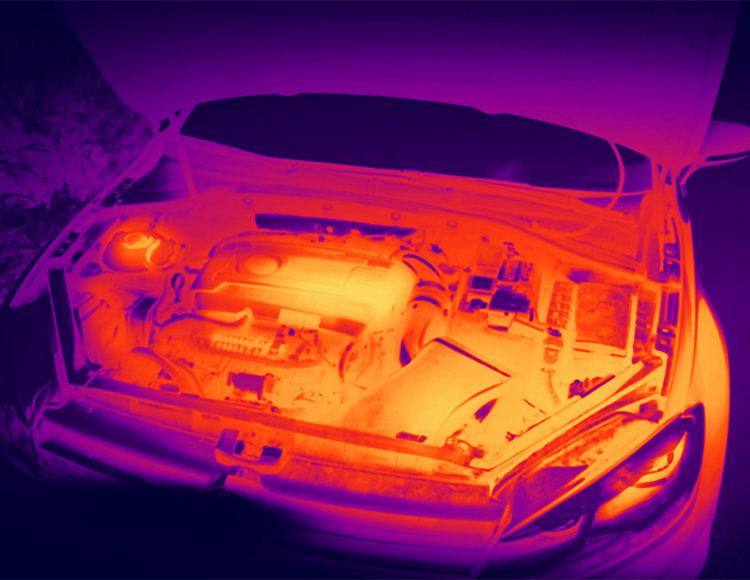
When You Need Both Distance and a Precise Temperature
You’ve probably been there. You see something that feels too hot or looks like it might be leaking, but you can’t get close. Or, you point a regular thermometer, but it only gives you a number – no idea if the spot is 2 feet or 20 feet away. Wouldn’t it be nice to know both at once?
A thermal picture looks cool, but it misses two big things
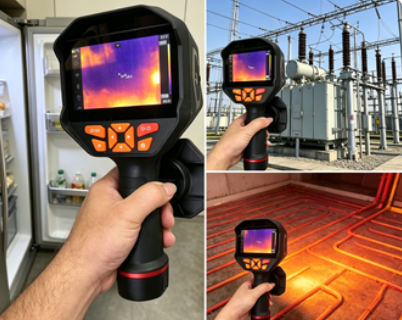
Thermal cameras show you red and blue blobs. You see where heat is, but you don’t know how far that spot is. And you don’t get a single, precise temperature for exactly the point you care about. You get an average over an area. For many small fixes around the house, that’s just not enough.
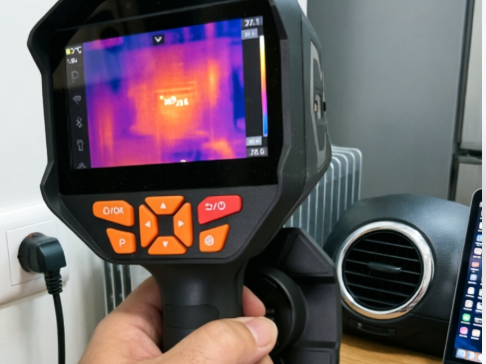
40-meter laser distance + spot thermometer mode – all in one
Imagine a tool that shoots a laser to tell you the exact distance (down to the millimeter) and gives you accurate temperature of a single tiny spot. No guessing. No climbing ladders to check. Just point, click, and you know both numbers instantly. That’s the idea.
Real-Life Example
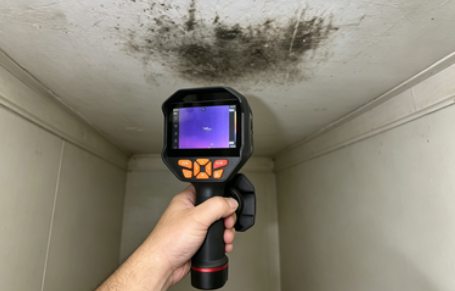
Your ceiling is stained, but is it still wet? And how high up is it? Let’s say you see a brown ring on your 15-foot ceiling. Is it an old stain or an active leak? With a regular thermometer, you can’t reach it. With this tool, you laser the spot – 14.2 feet up. Then switch to spot thermometer mode. It reads 58°F, while the dry ceiling around it is 72°F. That cold spot means moisture. Now you know exactly who to call, the roofer, without ever touching a ladder.
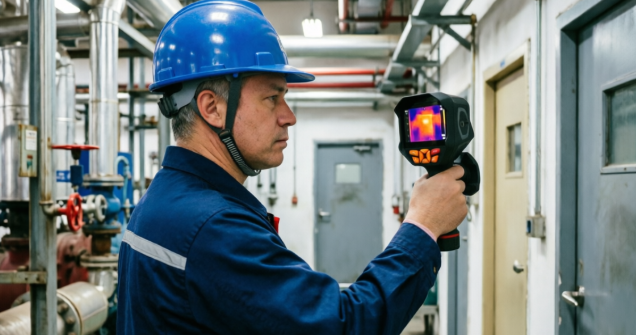
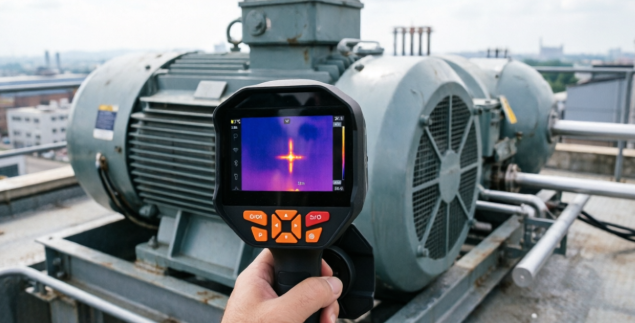
Let’s say you’re inspecting a motor unit mounted high on a production line, about 22 meters away. From the ground, everything looks normal. With laser distance mode, you first lock the target distance at 22.4 meters, so you know exactly what you’re measuring and avoid angle errors. Then you switch to spot temperature mode with distance compensation. The motor housing shows 88°C, while a nearby reference surface at the same distance reads only 64°C. That difference matters. Without distance correction, the reading could easily be underestimated or misleading.
When heating or cooling systems are not working evenly, the problem is rarely visible—but it can often be felt in temperature differences across the floor or vents. That cooler section reads 23°C, while the surrounding floor is stable at 28°C. That 5°C difference reveals uneven heating—possibly a blocked pipe or airflow issue. With laser distance mode, you quickly mark different test points across the room—for example 3.2 meters, 5.5 meters, and 7.1 meters from your position—so you can revisit the same spots without confusion. Instead of tearing up the floor or guessing from comfort alone, you can quickly pinpoint where the system is underperforming and decide what needs repair.
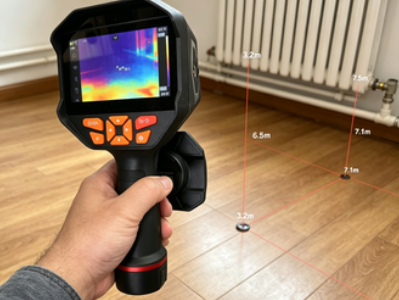
Meet the DP-38D– not complicated, just useful
These are simple handheld tools. They shoot a laser to measure distance up to 40 meters (that’s about 130 feet), with millimeter-level precision. Then, with one button, they switch to spot thermometer mode. No thermal imaging confusion. Just two numbers you can trust: exactly how far, and exactly how hot (or cold) that single point is.
More Everyday Uses
Check these around your home – you’ll be surprised.
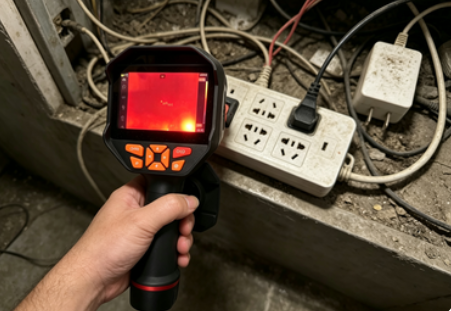
An electrical outlet: After running a space heater, point at the plug from 3 feet away. If it reads 140°F+, that’s a fire risk.
Refrigerator condenser coils: From 2 feet away, check the coils underneath. Dirty coils run at 120°F; clean ones run at 90°F. Now you know when to clean them.
Car AC vent: On a hot day, point at the center vent from 1 foot away. It should blow 40–50°F. If it reads 60°F, your AC needs a recharge.
Laptop power adapter: Touch it? It’s hot. But how hot? Laser reading from 1 foot: 158°F. That’s normal. 190°F? That’s failing.
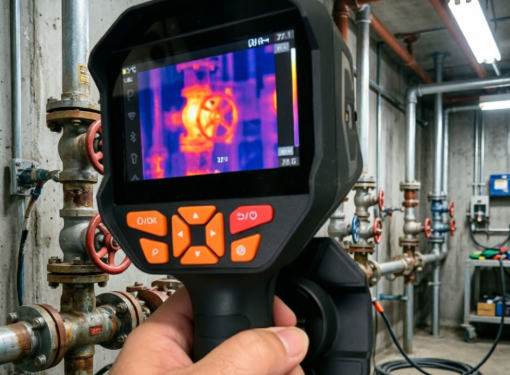
When have you wished you knew both the distance and the exact spot temperature?
Think about your own home. Maybe a warm floor, a high ceiling stain, a grill that cooks unevenly, or a plug that feels too hot. Leave a comment below – I’m curious what everyone would check first.