
Precise Screening of PV Module Defects: DP-64D High-Resolution Thermal Imaging Case Study
Application of 640×512 High-Resolution Thermal Imager DP-64D in the Precise Screening of Hidden Cracks and Thermal Blemishes in Photovoltaic Modules
Project Background and Challenges
During the production, transportation, installation, and long-term outdoor operation of photovoltaic power station components, various hidden defects such as battery sheet cracks, fragments, poor soldering, aging of grid lines, local shading and accumulation of dust are prone to occur. These defects are difficult to be identified with the naked eye and cannot be detected by conventional maintenance methods. Defective components will form local hot spots, which will continuously degrade the power generation efficiency over time, gradually expand the damaged area, and in severe cases, cause component burnout, branch circuit shutdown, and significant loss of power generation in the power station.
Traditional low-pixel infrared devices have insufficient resolution and are unable to detect fine cracks and micro heat spots. The large-scale inspection has a high rate of missed detections, making it unable to meet the requirements for precise operation and component acceptance. A large-scale distributed photovoltaic power station needs to conduct a comprehensive and detailed inspection of all its components and urgently requires an infrared fine screening solution with ultra-high resolution and high detail.
Technical Principles and Difference Analysis
(1) Core Technical Principles
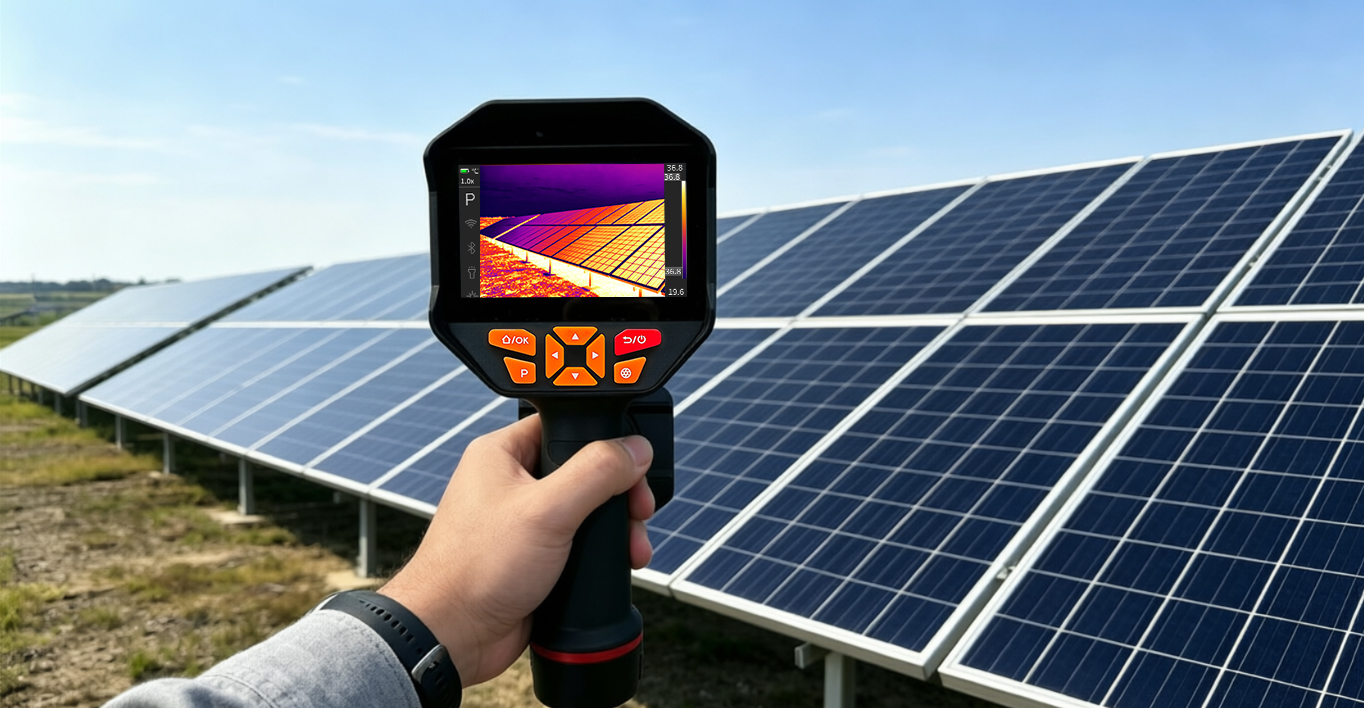
When there are hidden cracks, poor welding, or local defects in photovoltaic modules, the resistance within the faulty area increases, the power generation efficiency decreases, and more light energy is converted into heat energy, resulting in local fixed hot spots. The temperature of normal battery cells is uniform with a very small temperature difference; while defective battery cells will show local abnormal temperature rise. The 640×512 ultra-high resolution imaging of DP-64D can precisely distinguish the temperature differences of each battery cell, accurately capture small hot spots and hidden cracks, and achieve component-level precise defect determination.
Actual measurement thermal differences:
- Normal photovoltaic modules: Under normal light conditions, the module temperature is uniform, and the temperature difference between battery cells is ≤ 3℃.
- Defective photovoltaic modules: The temperature in the cracked and hot spot areas is 6–12℃ higher than the normal area, forming point-like or strip-like abnormal high-temperature areas, which are extremely concealed.
(2) Comparison Analysis of Traditional Detection Methods
- Manual visual inspection: Can only identify obvious damage and dirt, but cannot identify internal cracks and micro hot spots.
- Ordinary low-pixel infrared equipment: The imaging is blurry, the boundaries of battery cells are fused, and it is unable to distinguish small hot spots. A large number of hidden defects are missed.
- Inspection instrument sampling: The equipment is heavy, the efficiency is low, and it cannot conduct large-scale outdoor inspections. It is only suitable for laboratory sampling.
- DP-64D high-resolution thermal imager screening: The picture is detailed, the battery cell zones are clear, hot spots are accurately identified, and it can quickly screen a large number of modules.
Based on the requirements for high-precision defect identification and precise location and traceability, we have adopted the DP-64D high-resolution dual-light fusion thermal imager. By relying on ultra-high pixel resolution to capture minute thermal spot hazards, and combining with visible light real scene images to accurately locate component positions, it facilitates operation and maintenance rectification as well as the output of standardized reports.
Solutions and Implementation Process
To achieve high-precision, high-efficiency, and comprehensive defect screening for photovoltaic modules, a standardized operation process has been formulated:
Step 1: Condition Confirmation
Select periods with stable light conditions and when the modules are operating normally and generating electricity to conduct the tests. Ensure that the power and temperature conditions of the modules are stable to avoid the impact of light fluctuations on the accuracy of the tests.
Step 2: High-Precision Parameter Settings
- Enable high-definition temperature measurement mode: Activate the 640×512 full-pixel high-definition temperature measurement mode of the DP-64D to enhance the accuracy of identifying small hot spots.
- Set temperature difference alarm: Set the temperature difference alarm threshold to accurately identify local abnormal temperature rises of the battery cells.
- Enable dual-light fusion: Enable dual-light fusion imaging to ensure that the location of hot spots corresponds one-to-one with the physical modules.
Step 3: Fine Scanning of the Entire Array
Scan the photovoltaic modules group by group, string by string, and block by block, focusing on checking the strip-shaped and point-shaped thermal abnormal areas of the battery cells. Take high-definition images to retain the data of each module.
Step 4: Defect Classification and Archiving
Classify and mark the defects based on the size, temperature rise, and distribution of the hot spots. Establish a photovoltaic module defect ledger.
Abnormality Detection
- If a local battery cell of a component shows a fixed high-temperature area and the temperature difference exceeds 6℃, the equipment will trigger an audible and visual alarm.
- The high-temperature tracking function precisely locates the position of small hot spots, eliminating large-scale misjudgments.
- Combining dual-light images, the specific component number and location are accurately determined, and it is classified as a defective component and included in the rectification list.
Implementation Effectiveness
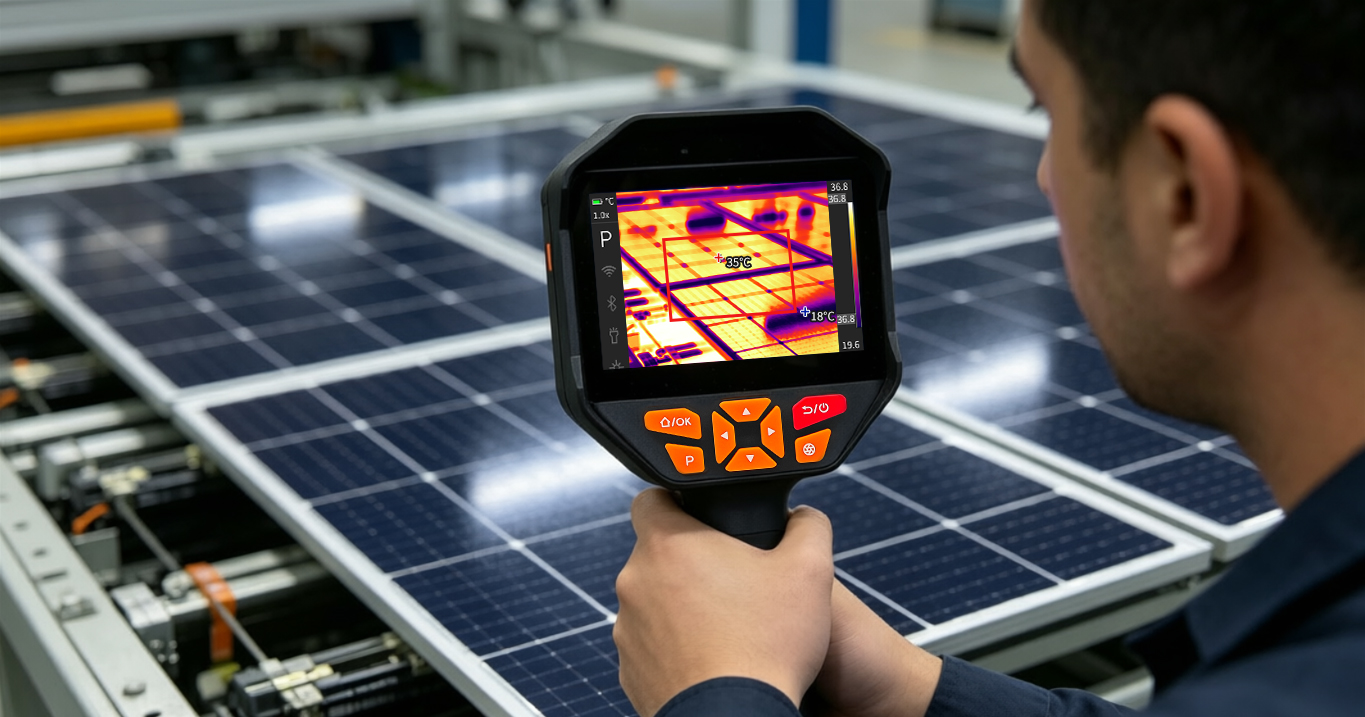
Through the DP-64D ultra-high resolution precision screening solution, the project team completed the comprehensive inspection of all photovoltaic modules in the station, identifying a total of over 120 defective modules with cracks, hot spots, and poor soldering, and all of these were rectified and replaced. This solution completely addresses the pain points of high missed detection rates in traditional inspections and the inability to identify minor defects, effectively improving the overall power generation efficiency of the power station, avoiding the expansion of faults due to continuous damage of the modules, significantly reducing the later maintenance costs, and providing a solid guarantee for the long-term, efficient, stable, and safe operation of the photovoltaic power station.
Scenario Expansion and Customized Services Description
The above standardized application cases fully demonstrate the core advantages of the DP-64D ultra-high resolution handheld thermal imager in the precise operation and maintenance of new energy photovoltaics. This device has extremely strong scene versatility and functional customizability. Apart from this scenario, it can be widely adapted to various scenarios requiring high details, high precision, and micro temperature difference identification, such as precise electronic quality inspection, lithium battery energy storage detection, precise maintenance of industrial equipment, power precise inspection, building energy efficiency detection, scientific research thermal analysis, and automotive thermal management testing.
According to the differences in working conditions of different industries, detection accuracy standards, temperature ranges, report output formats, and on-site operation requirements, we can provide exclusive customized solutions, including dedicated equipment parameter calibration, industry-specific pseudo-color and imaging mode customization, high-precision temperature difference threshold setting, software data traceability customization, on-site special technical training, and other complete supporting services. We can optimize the inspection plan one-on-one based on the actual working conditions of the customer to fully meet the diversified needs of various high-precision non-destructive testing, hazard detection, quality acceptance, and scientific research testing.