

How should the emissivity setting be done for temperature measurement with thermal imaging equipment?
In thermal imaging instruments, the concept of emissivity is often mentioned. That is, different materials have different emissivity values. When measuring temperature, the emissivity needs to be adjusted to ensure accurate temperature measurement.
The emissivity of the surfaces of some common metals is as follows:
|
Material |
Condition |
Approx. Emissivity (ε) |
|
Aluminum |
Highly Polished |
0.02 - 0.04 |
|
Oxidized / Rough |
0.20 - 0.40 |
|
|
Heavily Oxidized |
0.50 - 0.60 |
|
|
Copper |
Highly Polished |
0.02 - 0.05 |
|
Oxidized / Rough |
0.60 - 0.80 |
|
|
Stainless Steel |
Highly Polished |
0.10 - 0.15 |
|
Rough / Dull |
0.50 - 0.60 |
|
|
Oxidized |
0.8 |
|
|
Iron / Steel |
Highly Polished |
0.15 - 0.20 |
|
Rusted / Rough |
0.60 - 0.70 |
|
|
Heavily Rusted |
0.85 - 0.95 |
|
|
Lead |
Polished |
0.05 - 0.10 |
|
Oxidized |
0.60 - 0.70 |
|
|
Zinc |
Polished |
0.05 |
|
Oxidized |
0.40 - 0.60 |
In the table above, the emissivity of each metal varies significantly depending on the different surface treatments. In actual temperature measurement, it is difficult for ordinary people to accurately distinguish the various surface treatments, which may lead to incorrect setting of the emissivity and thus result in incorrect temperature data.
In fact, the parameters that affect the emissivity are as follows:
- Material type (the most fundamental factor)
The molecular structure and chemical properties of different materials determine their inherent ability to absorb and emit energy.
Non-metallic (insulators): such as plastics, rubber, paint, wood, human skin, etc., usually have a high emissivity (mostly between 0.85 and 0.98), very close to the ideal black body.
Metal (conductors): such as copper, aluminum, silver, etc., usually have a low emissivity (especially in polished state, it may be as low as 0.02 to 0.1).
Semiconductors: the emissivity is between the two, and it is affected by the doping degree.
- Surface roughness (extremely significant for metals)
The rougher the surface, the higher the emissivity; the smoother the surface, the lower the emissivity.
Smooth/Polished surface: like a mirror, it will reflect most of the infrared energy and has a very poor radiation ability (low emissivity).
Rough/Oxidized surface: the tiny unevenness will form a "cavity effect", and the infrared radiation will be reflected and absorbed in these depressions, thus significantly increasing the emissivity. For example, the emissivity of polished iron is only about 0.05, but rusty iron can reach over 0.6.
- Surface geometry
The physical form of the object's surface also affects the emissivity.
Areas with depressions, angles, holes, or unevenness on the surface will have a higher emissivity than the same part of the object with a smooth surface due to the presence of multiple reflections inside.
- Surface coating and treatment
Any substance that changes the physical or chemical state of the object's surface will directly change its emissivity.
Coating: spraying paint on the object's surface (even if it is shiny metal sprayed with ordinary paint, the emissivity will rise to above 0.9), applying electrical tape, applying thermal conductive silicone grease, or the natural oxide layer and rust on the metal surface, will significantly increase the emissivity.
Color misconception: Visual color (such as black or white) has almost no effect on infrared emissivity. For example, the infrared emissivity of black paint and white paint is both approximately 0.95. Color mainly affects the absorption of visible light (such as sunlight), which is why black cars are hotter than white cars in summer, but this is not the same as the object's ability to radiate infrared heat (emissivity).
- Temperature and measurement wavelength
Temperature: The emissivity changes with temperature, but the pattern is not uniform. The emissivity of most non-metallic materials slightly decreases with the increase in temperature; while the emissivity of most pure metals increases with the increase in temperature.
Wavelength: The detectors of different infrared thermometers have different response bands (such as short wave and long wave), and the emissivity values measured for the same object in different bands will also be different.
In conclusion, for ordinary users, it is extremely difficult to obtain accurate emissivity by modifying the emissivity parameters. However, in actual production and life scenarios, it is necessary to measure the surface temperatures of objects such as metals and glass, which have very difficult-to-obtain accurate emissivity. So, what should be done?
The figure below shows the specific measurement methods:
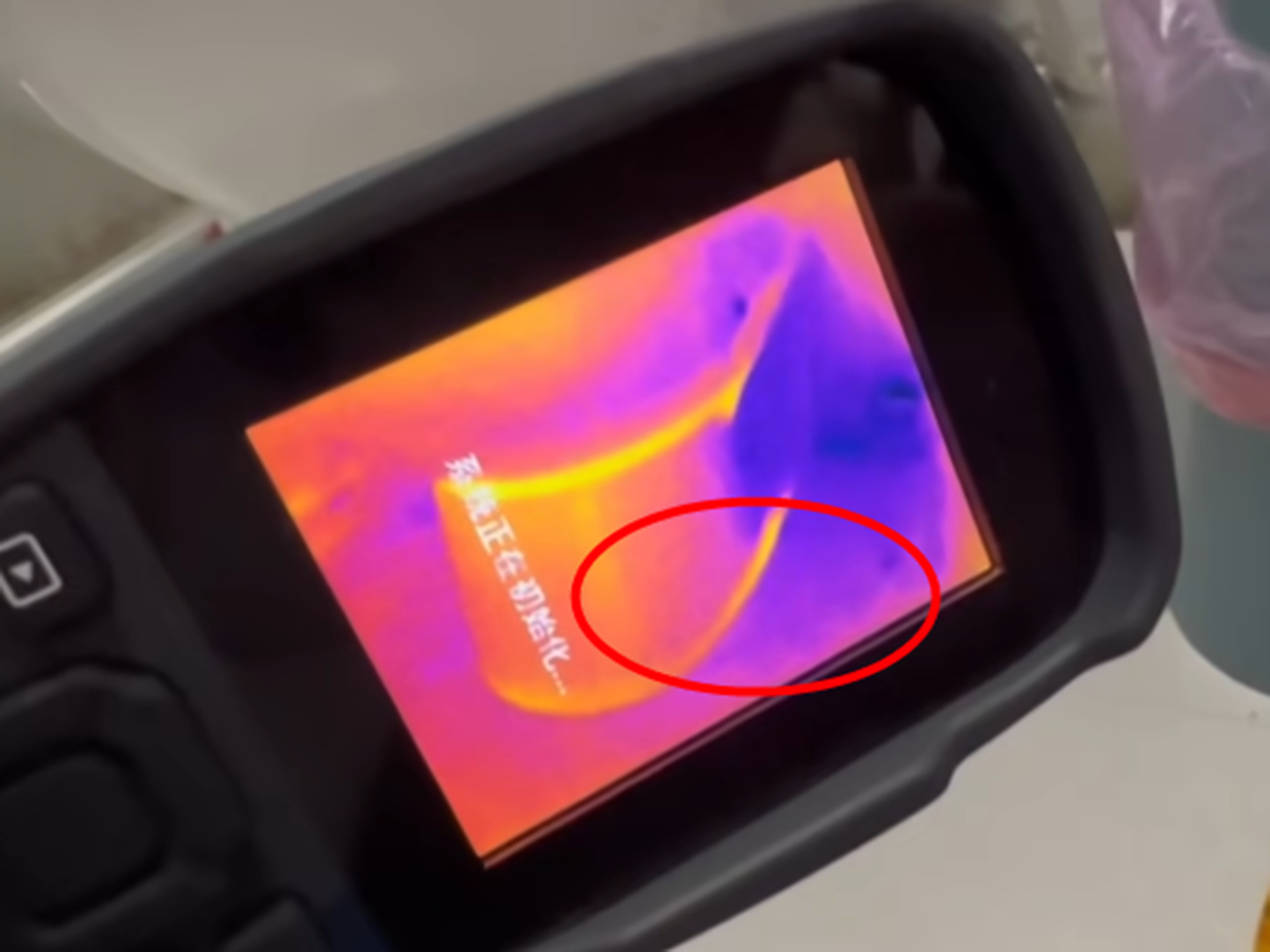
The two pictures below were taken using visible light and thermal imaging. In both pictures, the hot water almost filled the entire pot, and the water temperature was already close to boiling. However, it can be seen that the temperatures measured on the metal parts of the pot were all inaccurate. Moreover, due to the material, roughness, and shape uncertainties, it is not easy to set the emissivity. When using the default emissivity of 0.99 for measurement, the water temperature was only 40.5°C, indicating a significant deviation in the measurement.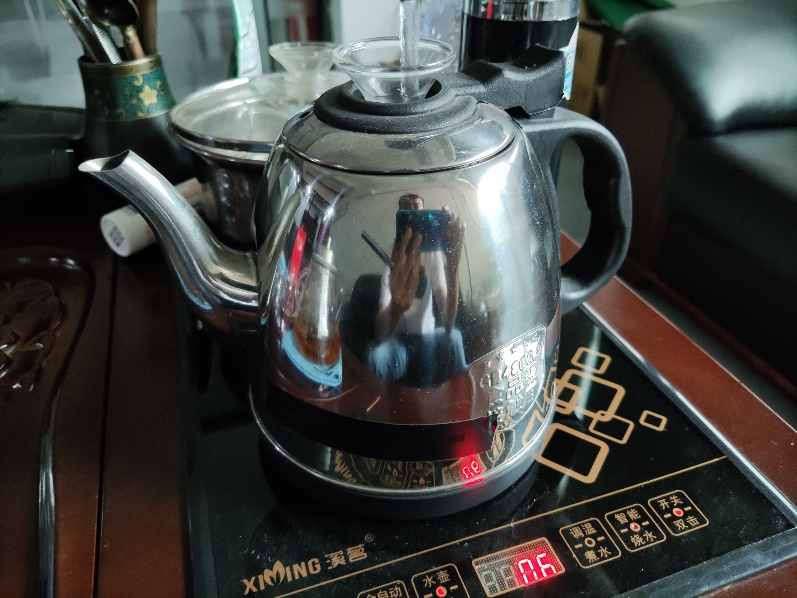
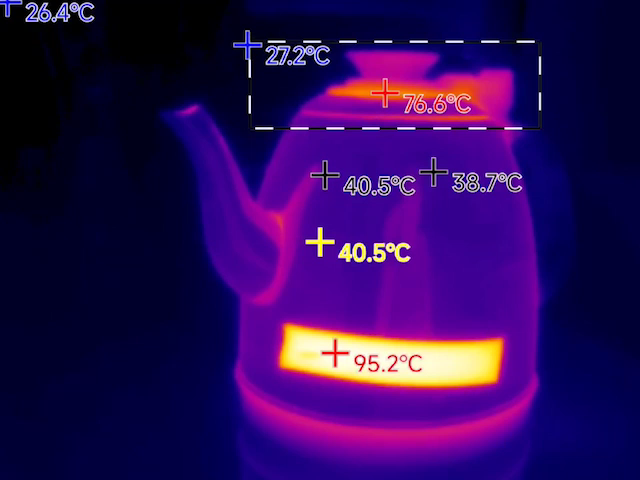
In the above picture, the material of the water kettle is not confirmed to be steel or iron. Moreover, the surface is very smooth and it is an arc shape rather than a flat surface. Therefore, we can stick a large piece of black electrical tape on the surface of the water kettle. Since the emissivity of electrical tape is usually 0.95, by measuring the temperature of the electrical tape, we can obtain the current temperature of the kettle. Even if a known object is stuck on an unknown object surface, once the temperature stabilizes, the measured temperature will be very close to the actual temperature.
Therefore, when using an infrared thermal imager to measure an object, if the emissivity is unknown, a known material can be used to replace the unknown surface. In this way, the measurement can become much more accurate.